In the modern world of luxury watch collecting, most attention revolves around famous Swiss maisons such as Omega, Patek Philippe, and Jaeger-LeCoultre. Yet long before mass luxury production reached global prominence, an entirely different category of timepieces quietly existed behind royal courts, government circles, and high-level protocol environments across the Middle East.
Among the rarest of all were the special Saudi-issued watches commissioned during the reign of King Abdulaziz Al Saud between the 1930s and 1940s — a formative era in the creation of modern Saudi Arabia.
These were not ordinary commercial watches sold in boutiques or public markets. Instead, they were handcrafted Swiss-made pieces produced in highly limited numbers inside private workshops, often by special request for governmental entities, official circles, or elite figures associated with the emerging Saudi state.
Today, surviving examples are considered among the rarest and least documented categories of historical Middle Eastern horology.
A Forgotten Era Before Commercial Luxury Dominated The Market
During the 1930s and early 1940s, the global watch industry operated very differently from the modern luxury landscape collectors know today.
Many watches produced for governments and royal circles were not necessarily signed by major brands on the dial. In fact, numerous important commissions were manufactured anonymously inside specialized Swiss ateliers that focused exclusively on custom-made protocol pieces.
These workshops often collaborated with or sourced movements from respected Swiss manufacturers while producing handmade dials, custom enamel artwork, engraved symbols, and region-specific iconography.
Unlike later decades where branding became central to luxury identity, these early special commissions prioritized symbolism, diplomacy, and presentation above commercial recognition.
For Saudi Arabia during the era of King Abdulaziz, such watches represented more than functional objects — they reflected the visual identity of a newly unified kingdom emerging onto the world stage.
The Rise Of Saudi Government-Commissioned Swiss Watches
As Saudi Arabia entered a period of political consolidation and international presence under King Abdulaziz, specially commissioned objects became increasingly important in diplomatic and governmental culture.
Swiss workshops began receiving requests to create unique watches tailored specifically for Saudi officials, governmental presentations, ceremonial gifts, and elite circles connected to the state.
Unlike mass-produced commercial references, these watches were often produced in astonishingly small quantities — sometimes no more than 10 to 15 examples for an entire design.
Each piece was typically handcrafted individually, making slight variations between surviving examples possible today.
The rarity of these watches was not a marketing strategy. It was simply the nature of how such pieces were produced during that period.
Why Many Of These Watches Carried No Brand Name
One of the most fascinating aspects of early Saudi special-issue watches is the absence of visible branding on many dials.
Modern collectors often associate value with recognizable names. However, during the 1930s and 1940s, some of the most important protocol pieces carried little or no commercial identity at all.
This occurred for several reasons:
- The watches were commissioned privately rather than commercially.
- The artistic symbolism held greater importance than the manufacturer's name.
- Production often took place inside independent Swiss workshops rather than centralized factories.
- Governmental or ceremonial identity overshadowed retail branding.
In many cases, workshops sourced Swiss movements from respected makers while focusing their craftsmanship on custom dial production, enamel work, and symbolic hand-painted elements.
This explains why some surviving Saudi examples feature exceptional artistry despite lacking major commercial signatures.
Ironically, this absence of branding is now part of what makes these pieces so historically captivating.
The Influence Of Swiss Houses Like Omega, Jaeger-LeCoultre, And Patek Philippe
Although many Saudi special commissions from this era remained unsigned, the broader ecosystem behind such watches was deeply connected to the Swiss horological world.
Companies such as Omega became especially influential in Middle Eastern governmental and royal commissions throughout the twentieth century due to their reliability, adaptability, and willingness to create custom-issued pieces.
Similarly, Jaeger-LeCoultre and Patek Philippe established reputations for refined craftsmanship suitable for diplomatic gifting and elite protocol environments.
However, beyond these famous maisons existed a network of lesser-known Swiss ateliers and specialist workshops capable of producing entirely bespoke creations outside traditional retail channels.
These independent ateliers played a major role in shaping the visual identity of many early Middle Eastern ceremonial watches.
Handcrafted Dials And The Art Of Enamel Work
Perhaps the most extraordinary feature of these Saudi watches lies in their dials.
Unlike modern printed dials produced industrially, many early Saudi special issues involved hand-executed artistic techniques including enamel painting, miniature illustration, symbolic engraving, and custom calligraphy.
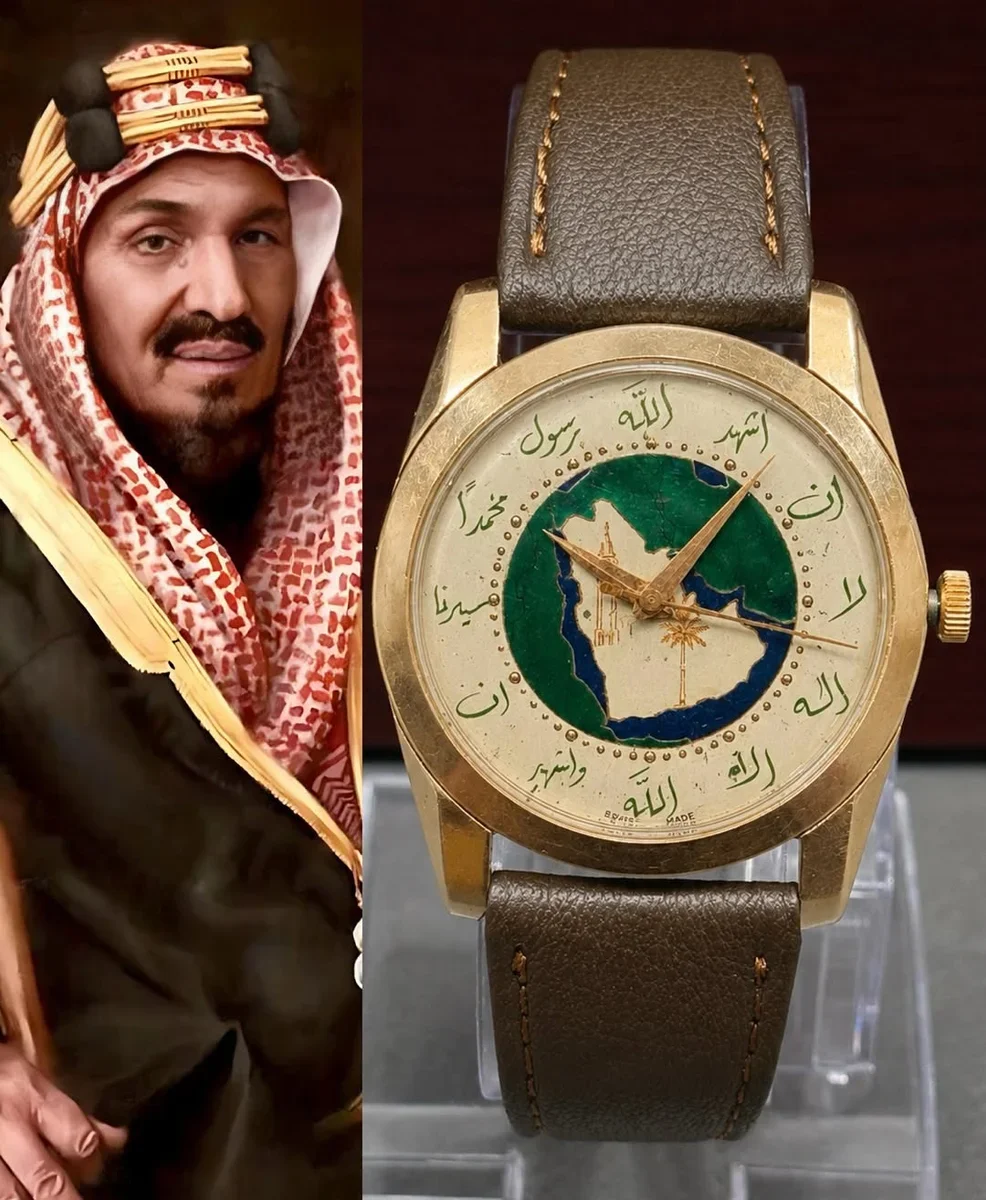
One of the most remarkable surviving examples features:
- A hand-rendered map of Saudi Arabia
- Islamic testimony inscriptions distributed around the hour markers
- Hand-painted decorative detailing
- Traditional Swiss mechanical craftsmanship
The artistic execution transforms the watch from a simple timekeeping instrument into a miniature cultural artifact.
In many cases, these dials required painstaking manual labor by specialized artisans working under magnification inside Swiss workshops.
This level of handcrafted individuality means no two pieces age identically today.
A Surviving Example From The Era Of King Abdulaziz
Among the most compelling surviving examples known today is a rare Saudi watch dating to the era of King Abdulaziz.
The piece features a remarkable dial centered around the map of Saudi Arabia, surrounded by Arabic calligraphic placement of the Shahada across the numeral positions — an artistic configuration rarely encountered in vintage horology.
Its visual identity immediately separates it from conventional Swiss production of the period.
The watch embodies many defining characteristics associated with early Saudi governmental commissions:
- Handcrafted artistic dial work
- Regional symbolism
- Limited production nature
- Swiss mechanical foundations
- Absence of commercial mass-market design language
Most importantly, it reflects an era where watches served not merely as luxury accessories, but as symbolic representations of national identity, prestige, and ceremonial culture.
Why These Watches Are Among The Rarest Middle Eastern Collectibles Today
Today, collectors across the world aggressively pursue signed vintage pieces from famous brands. Yet truly historic Middle Eastern watches from the pre-commercial protocol era remain vastly rarer.
Several factors contribute to their extreme scarcity:
1. Tiny Original Production Numbers
Many examples were produced in quantities estimated between 10 and 15 pieces only.
2. Fragile Handcrafted Construction
Hand-painted enamel and artistic dials were highly delicate and vulnerable to damage over time.
3. Lack Of Documentation
Because these watches were privately commissioned, official archival material is extremely limited.
4. Historical Loss
Wars, environmental conditions, inheritance fragmentation, and decades of neglect caused many examples to disappear permanently.
5. Cultural Underrecognition
For decades, global collectors focused heavily on European sports watches while overlooking historic Middle Eastern protocol pieces.
Only recently has appreciation begun growing for these extraordinary artifacts.
More Than Watches — Historical Documents In Miniature Form
To view these watches merely as vintage accessories would be a misunderstanding of their true significance.
They represent a unique intersection between:
- Early Saudi state history
- Swiss artisanal craftsmanship
- Political symbolism
- Islamic artistic expression
- Diplomatic culture
Each surviving piece acts almost like a wearable historical document from one of the most transformative eras in Arabian history.
Unlike modern luxury watches produced in thousands of units annually, these early Saudi special commissions belonged to a world where exclusivity was not manufactured through advertising — it existed naturally through craftsmanship, scarcity, and purpose.
The Growing Global Interest In Royal And Government-Issue Watches
In recent years, collectors have increasingly shifted attention toward royal, military, and governmental watches carrying historical provenance rather than purely commercial prestige.
This has led to growing demand for:
- Rare Saudi watches
- Middle Eastern royal timepieces
- Historical Arab horology
- Government-issued Swiss watches
- Handcrafted protocol pieces from the Gulf region
For serious collectors, originality, symbolism, and historical relevance now carry as much importance as brand recognition itself.
As awareness continues expanding, surviving Saudi watches from the era of King Abdulaziz may ultimately become recognized among the most historically important Middle Eastern horological artifacts ever produced.
Preserving A Nearly Lost Chapter Of Horological History
At Golden Age — Private Collectibles House, preserving these rare historical pieces goes beyond collecting luxury watches.
It is about documenting overlooked chapters of regional craftsmanship, royal protocol culture, and early governmental artistry that would otherwise risk disappearing from memory.
The surviving Saudi special-issue watches of the 1930s and 1940s are not merely rare because few remain.
They are rare because they belong to a world that no longer exists — a world where handcrafted Swiss ateliers quietly produced miniature symbols of national identity for one of the most historically significant eras in Saudi history.